
SaaS Pipeline Blame Game
Why the trust gap between sales and marketing kills SaaS growth—and how top teams align with joint pipeline retros.

Andrew Hatfield
June 30, 2025

CEO & Founder, Deepstar Strategic
Intro: The Real Pain Behind the Pipeline
Ever walked out of a pipeline review thinking, “Are we even working at the same company?”
You’re not alone. In B2B SaaS—especially as you cross $5M or $10M ARR—the single biggest drag on growth isn’t your product. It’s the trust gap between sales and marketing.
Too many companies waste cycles finger-pointing, debating metrics, and doubting the numbers—while real pipeline opportunities slip away.
Episode Highlights & Timecodes
- 00 – Boost Pipeline Velocity NOW
How misalignment slows revenue—and what to do today. - 01 – Unlock Growth with Joint Pipeline
The single retro agenda that transforms trust and execution. - 03 – Bridging the Sales & Marketing Trust Gap
The proven playbook that unites revenue teams for good.
The Hard Truth: Why This Problem Persists
Despite all the dashboards, tech, and meetings, most teams still face:
- Mismatched metrics: Marketing obsessed with MQLs, sales focused on closable pipeline.
- Broken handoffs: Unclear definitions of “qualified” mean deals fall through the cracks.
- Language barriers: Teams talk past each other, never fully aligned.
Direct from the field:
A VP Revenue told me:
“We waste hours every week wrangling spreadsheets just to answer basic pipeline questions. By the time we agree, the opportunity’s already gone.”
A CEO admitted:
“I see four different revenue numbers every QBR—no one knows which to trust. Pipeline reviews turn into data debates, not decisions.”
Why It Matters: The Data
- 62% of GTM leaders say their teams spend more time collecting and reconciling data than actually acting on it.
(2024 Deepstar Strategic GTM Efficiency Survey) - Benchmarkit found the average $20M SaaS company wastes 14–20 hours per manager, per week, just prepping metrics.
- ChartMogul: 50% of revenue ops pros see analytics as a bottleneck—not an accelerant.
How Top Teams Fix It: The Playbook
1. Align on Shared Metrics
- Use fewer dashboards—ones everyone trusts.
- Stop debating numbers.
- Agree on what counts as a real, qualified opportunity (and put it on the wall).
2. Run Joint Pipeline Retros
Adopt a simple, three-step agenda:
-
Win/Loss Stories:
Share real deals won and lost. No blame—only learning. -
Definition Alignment:
Update what “qualified” means every quarter. Everyone signs off. -
Action Planning:
Each team commits to one change, with owners and deadlines.
3. Bridge the Gap with AI + MCP
- Connect AI directly to live datasets with Model Context Protocol (a way to connect AI to your existing systems).
- No more exporting data, no more stitching reports—just real-time answers everyone can trust.
Take Action: Try This at Your Next Review
Here’s how you can start this week:
- Audit your dashboards: Are numbers different for the same KPI?
- Ask, “If you had instant access to any data point, what would you want to know?”
- Pilot tools that give you real-time, unified answers.
Remember:
Less stitching. More acting.
The real growth engine isn’t another dashboard—it’s building trust across your revenue team.
Let's Discuss Your AI StrategyLet's Discuss Your AI Strategy
30-minute discovery call to explore your AI transformation challenges, competitive positioning, and strategic priorities. No pressure—just a conversation about whether platform independence makes sense for your business.
Dive deeper into the state of SaaS in the age of AI
Understand the market forces reshaping SaaS—from platform consolidation to AI-native competition
 The State of SaaS in the Age of AIThe Constraint Nobody's Modeling
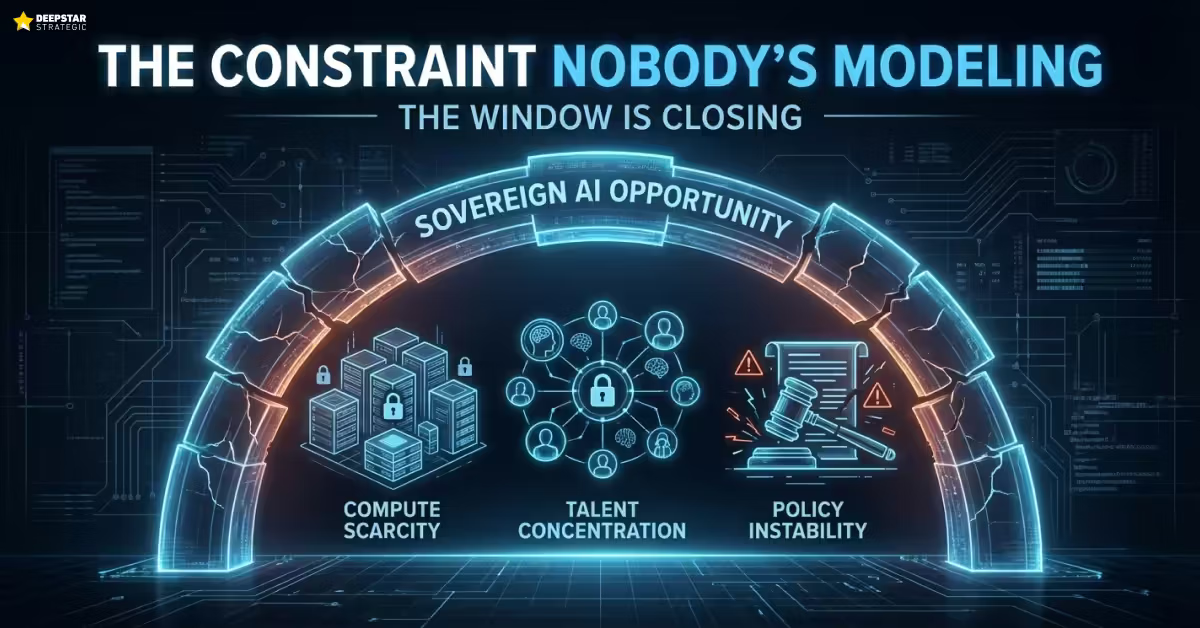
Every AI sovereignty strategy makes the same assumption: when you're ready to build independence, the resources will be available. Analyze the economics and you'll find that assumption is wrong. Compute is concentrating. Talent is concentrating. Policy is unstable. The window is closing.
Andrew HatfieldDecember 9, 2025
 The State of SaaS in the Age of AIThe Dependency Architecture Being Built for Allies
OpenAI's 'sovereign deployment options' sound like independence. The US government's AI Action Plan describes these as partnerships. Read the actual documents and you'll find explicit language about 'exporting American AI to allies.' That's not a sovereignty framework—it's a dependency architecture with better PR.
Andrew HatfieldDecember 9, 2025
 The State of SaaS in the Age of AIWhat National AI Strategy Teaches SaaS Companies
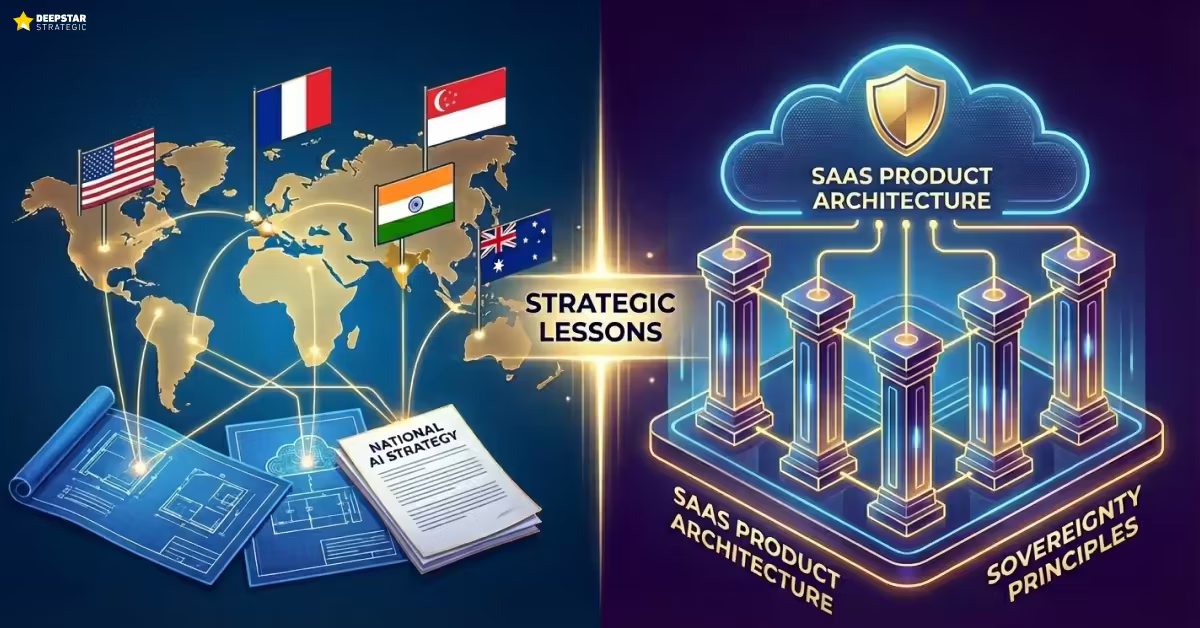
France, Singapore, India, and the UK collectively spent tens of millions developing AI sovereignty strategies. The conclusions are public. They translate directly to your product architecture decisions. Most SaaS product teams haven't read a single one.
Andrew HatfieldDecember 9, 2025
 The State of SaaS in the Age of AIWhat 'Sovereign AI' Actually Means for Your Product Strategy
France is spending €109 billion on AI infrastructure. Singapore admits GPUs are in short supply and they face 'intense global competition' to access them. Your product team is debating whether to increase OpenAI API spend by 20%. These aren't different conversations—they're the same conversation at different scales.
Andrew HatfieldDecember 9, 2025